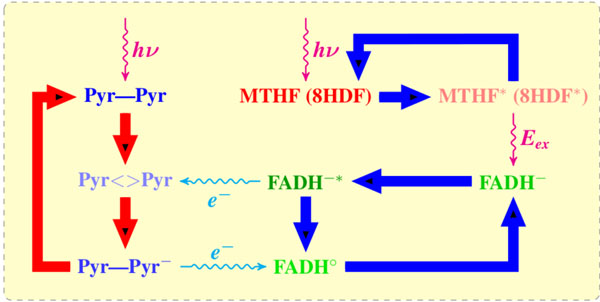
Fig. (1) A reaction mechanism of blue light-mediated repair of CPD lesion by DNA PHTs (photolyases). The UV influence damages the DNA neighboring pyrimidines (Pyr–Pyr) and induces a CPD (Pyr<>Pyr) lesion. The cofactor (MHTF or 8-HDF) adsorbs light photon and transfers it to a catalytically active flavin (FADH–) as an excitation energy Eex via dipole–dipole interaction. The flavin molecule (FADH-*) transfers an electron to CPD. The CPD splits out into two pyrimidines, thereby transferring back the electron to a newly formed FADHo; in its final state the flavin molecule has to pass into a catalytically active form.