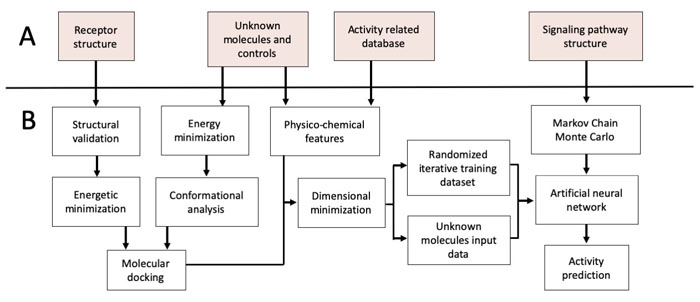
Fig. (1)
Diagrammatic workflow of the computational strategy for ligand prediction over SP architecture. The pipeline for the strategy implementation uses a receptor crystallographic structure, structure of the unknown ligands, known ligands data interacting with the receptor of interest and SP architecture. The SP must interact with the receptor by signaling cascade of secondary messengers and be triggered by the interactions of known and unknown ligands with the receptor. A) Input of biological information B) Computational methods to predict the activity of a series of ligands. Subgroups of computational methods aim to represent biological stages of the SP response to external ligands: 1) Structural validation, energy minimization, conformational search and molecular docking stand as protein ligand complex and 2) Markov Chain Monte Carlo and Artificial neural network as methods to generate a quantitative model with SP architecture embedded. Physico-chemical featuring, dimensional minimization and training/testing datasets were implemented to integrate the structural data with the systemic model of the SP and the machine learning model.