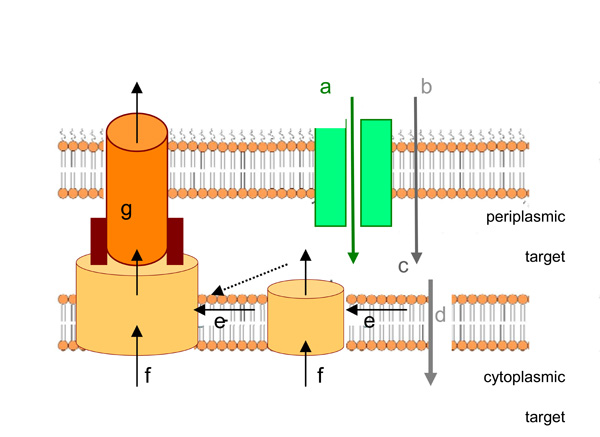
Fig. (1) Antibiotic transport through the membranes of Gram-negative bacteria (reproduced from [168]).To be active against bacterium, an antibiotic needs a critical concentration threshold to inhibit the corresponding target. Using the concentration gradient, the influx is controlled by several elements: the antibiotic can permeate through the OM via porins (a, for hydrophilic molecules) or through the OM (b, for hydrophobic drugs). (c) represents the diffusion through the periplasmic space in which enzymatic inactivation may occur. Finally, the drug will pass the cytoplasmic / IM (d).Regarding the efflux, the drug may be recognized and transported by active pump (e) or (f). The pump (e.g. AcrB) has to recruit the OM pore TolC (g), in addition it may conjointly acts with other pumps (e.g. MFS family). The success of a drug is given by the kinetics of all individual steps.